Community Experience · F&B Strategy · Marketing Leadership
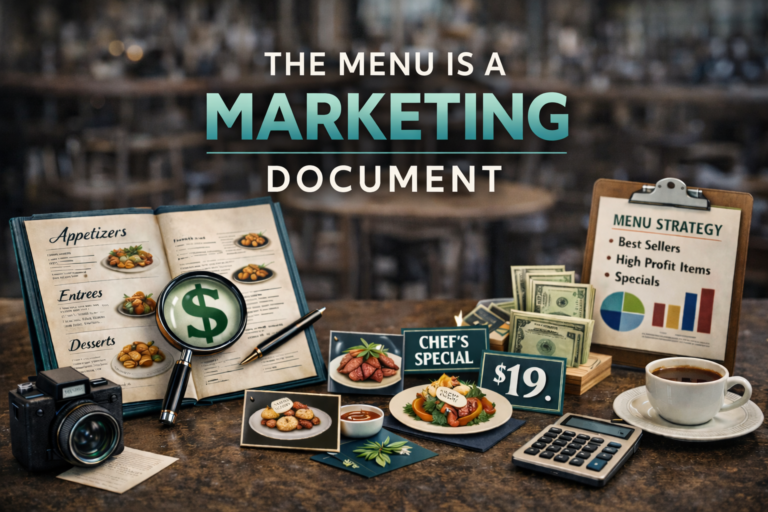
The Menu Is a Marketing Document
How Thoughtfully Curated F&B Turns a Dining Space Into a Community — and a Community Into a Competitive Advantage
There is a moment that every community manager recognizes — the point where a space stops being an amenity and becomes a place. It’s the Tuesday morning a resident sits down at the clubhouse café and runs into a neighbor she hasn’t properly talked to in six months. The Sunday evening a family claims their usual table near the fire pit. The after-work ritual that makes a commute feel worth it. These moments don’t happen by accident. They are designed. And the design starts long before the first guest sits down.
At Access Management, we work at the intersection of community operations and resident experience every day. What we’ve watched unfold across the industry is a fundamental shift in what the dining amenity actually is. It is no longer just a perk. It is infrastructure for belonging. And how you build it — specifically, how you curate what’s on the menu and how that menu sits within the larger community narrative — determines whether you’ve built something residents come back to or something they quietly ignore.
“A restaurant inside a community is not a restaurant. It is a retention tool, a leasing differentiator, and a living expression of your brand — if someone is paying attention to all three simultaneously.”
Organizational Strategy
Lifestyle Executes. Marketing Orchestrates.
It’s a distinction that’s easy to blur when both teams are moving fast — and one the industry doesn’t always draw cleanly. At Access Management, it’s something we’ve been intentional about from the start.
Lifestyle teams are exceptional at execution — programming the calendar, running the events, keeping the energy alive on-property. That operational skill is irreplaceable. But execution without strategy is activity. It fills time without building equity. The question lifestyle alone doesn’t always answer is: why does this particular dining experience reflect who we are as a community, who we’re trying to attract, and what story we want a resident to tell their colleague when they invite them over for dinner?
That’s a marketing question. It has to be answered first — before a menu item is chosen, before a vendor is selected, before a pop-up chef’s dinner gets put on the calendar. Marketing strategy defines the resident persona. It determines the emotional register of the experience. It identifies which properties are a competitive threat and what those communities are offering. It creates the narrative framework inside which lifestyle then operates. Without that framework, you end up with a dining space that’s fine — but forgettable. And forgettable doesn’t renew leases.
Menu Design & Brand
What the Menu Actually Communicates
Every menu is a positioning statement. Residents may not consciously articulate this, but they feel it immediately. A menu of pre-packaged grab-and-go items tells a story about efficiency and indifference. A rotating seasonal menu developed with a local vendor partner tells a completely different story — about intention, about the community’s connection to where it exists, about a management team that believes residents deserve more than the generic.
The specific choices matter less than the coherence. A relaxed, neighborhood-feel community doesn’t need a menu that aspires to be a boutique hotel. It needs a menu that feels like it belongs to that place: familiar but elevated, approachable but not lazy. A luxury high-rise needs something that matches the visual and experiential register of everything else on-property. The food has to make sense in context. When it does, residents don’t just enjoy a meal — they feel understood.
“The question is never ‘What should we serve?’ The question is ‘What does this food say about us — and is that the story we want to tell?'”
This is where marketing’s role is most tangible. Resident persona work, competitive audits, brand voice guidelines — these are not abstract documents that live in a shared drive. They are the brief that a food and beverage program should be designed against. When that brief exists, the dining space makes sense as part of a whole. When it doesn’t, the dining space becomes an expensive afterthought that underperforms its footprint.
Resident Retention
Turning the Dining Space Into a Neighborhood Anchor
The highest-performing community dining spaces have one thing in common: residents treat them like they’re theirs. Not in the sense of ownership — but in the sense of belonging. They have their table. Their order. Their day of the week. This is not a coincidence of good food alone. It is the result of consistent, intentional programming layered on top of a reliable product.
Cooking classes. Wine pairings with local producers. Pop-up dinners where a guest chef from the neighborhood brings something new. Informal happy hours where the food is secondary to the gathering — but good enough that the gathering keeps happening. Seasonal menus that give long-term residents something to look forward to, and give new residents a conversation starter. Each of these programs is a retention mechanism dressed as an experience.
The resident who attends the monthly chef’s dinner is not just someone who likes good food — they are someone building a social life within the property. That social infrastructure is exactly what a competing community cannot replicate by dropping its rent $50. You cannot manufacture a table that feels like yours. The financial case is direct: turnover in multifamily communities costs roughly $4,000 per unit when you factor in vacancy, make-ready, and leasing costs. A well-run dining program that converts even a handful of uncertain renewal decisions into “yes” each year has paid for itself.
Integration & Marketing Architecture
The Loop Most Properties Leave Open
Even well-intentioned communities often treat the dining program as a standalone operation. The food is decent, the space is nice, but nobody has connected the dots between what happens at that table and what goes into a renewal conversation, a leasing tour, a social post, or a resident satisfaction survey.
Marketing’s job is to close that loop. When a new resident moves in, are they introduced to the dining program in a way that creates immediate attachment — or handed a brochure? When a leasing prospect tours the property, is the café staged and staffed so the experience feels real — or is it empty and fluorescent-lit? When a seasonal menu changes, is there a moment of resident anticipation built through communication — or does it just quietly change?
“The dining experience is not an island. Every plate served, every event hosted, every seasonal reveal is a brand touchpoint — and brand touchpoints compound over time.”
Integrating a food and beverage strategy into the broader resident journey — from prospect to long-term resident — is a marketing architecture problem. It requires someone thinking across all the touchpoints simultaneously, not just managing the individual event or the individual menu. When that function exists, the dining program becomes a chapter in a story rather than a standalone scene.
Revenue & ROI
What Incremental Value Actually Looks Like
Incremental value in the context of a community dining program is worth making concrete. It is not just about revenue from food sales. It is about the value added at each stage of the resident relationship.
During leasing, a dining program with a clear point of view — a menu that reflects the community’s personality, a visible calendar of events — shifts perception from “apartment complex with a café” to “community where I could actually see my life.” That perception change influences decisions at the margin. It tips the hesitant prospect. It justifies a higher rent band.
During residency, regular dining engagement reduces the psychological distance between a resident and the property. They are not renewing a contract; they are staying somewhere they’ve built habits around. At the moment of renewal, a resident who has attended six events in the dining space and has a regular Wednesday morning coffee order is not the same retention risk as someone who has never engaged with the amenity. The dining program has done quiet, continuous work on your behalf — but only if someone was directing that work with intent.
Long-Term Strategy
Building a Program That Compounds
The communities getting this right are not necessarily those with the biggest budgets or the most elaborate menus. They are the ones treating the dining program as a compounding asset — something that builds equity with each interaction, each consistent experience, each resident who becomes a regular.
That compounding requires a clear strategy, a menu that earns trust over time rather than trying to impress on day one, programming that gives residents reasons to return rather than one-time spectacles, and a marketing function that keeps all of it connected to the broader story the community is telling. A dining space that knows what it is — and communicates that consistently, in every detail from the menu design to the weekly special — is a competitive advantage that cannot simply be copied.
Competitors can build the same café. They cannot replicate the story that’s already been told inside yours.
Let’s Connect
Looking for a property management partner that truly makes a difference in your community? We’d love to hear from you.